Made with Love Hand Lettering
First Impressions: Romantic, Refined, and Ready for Real Stitches
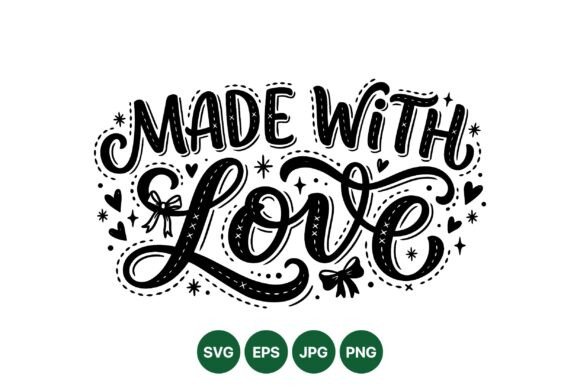
When I opened the Made with Love Hand Lettering ZIP folder, what struck me wasn’t just the black-and-white elegance—but how instantly *usable* it felt. This isn’t a decorative flourish you’d tuck into a corner of a layout and forget. It’s a complete phrase—“made with love”—rendered in flowing, confident hand lettering, anchored by delicate ribbon bows, soft hearts, and subtle star symbols. The spacing breathes. The curves feel intentional, not rushed. And because it’s delivered as clean black-and-white graphics, it translates beautifully to embroidery without visual noise or color dependency. It sets an elegant, heartfelt mood—ideal for products where warmth and sincerity matter more than flash.
A Real Project Test: Embroidering a Keepsake Baby Towel
Last week, I prepped Made with Love Hand Lettering for a custom kitchen towel destined for a baby shower gift—soft organic cotton, light gray base, stitched in matte black thread. I chose this project deliberately: it demands clarity at modest scale, gentle contrast, and emotional resonance. The design held up remarkably well. The lettering stayed legible even at 3.5 inches wide; the hearts and bows retained their charm without becoming pixelated or overly dense. Customers notice that kind of care—the kind that says “this wasn’t slapped on, it was chosen.” That’s the quiet strength of Made with Love Hand Lettering: it doesn’t shout. It invites.
Where It Shines (and Where It Needs Thought)
Made with Love Hand Lettering is especially effective on:
- Tote bags and aprons—its balanced width and vertical rhythm anchor the front panel without overwhelming;
- Sweatshirts and baby onesies—the open letterforms avoid tight satin-stitch traps common in cursive scripts;
- Pillow covers and tea towels—the black-and-white simplicity reads cleanly from across a room;
- Embroidered patches—it scales down well for 3–4 inch hoops, and the minimal detail keeps stitch count manageable;
- Holiday and wedding gifts—its romantic tone lands authentically, never kitschy.
But be thoughtful when applying it to:
- Stretchy fabrics like knits or lightweight jerseys—the ribbon loops and heart curves need solid stabilization to prevent distortion;
- Dark or textured fabrics—test thread contrast first; matte black on charcoal can disappear without a tonal shift or outline stitch;
- Caps or curved surfaces—the horizontal flow works best on flat or gently contoured areas; avoid placing near the crown seam unless resized and repositioned;
- Small hoop sizes under 3 inches—the star symbols and bow tails may lose definition; simplify or omit one accent element if needed;
- Frequently washed items like baby clothes—confirm your fill stitch density supports durability; too sparse, and hearts may fray over time.
What It Adds to Your Finished Product
As a designer who ships embroidered goods daily, I pay attention to how a design affects perceived value—and Made with Love Hand Lettering consistently lifts it. Its handmade aesthetic reinforces authenticity. Customers don’t see “a font”; they see intention. That matters for Etsy sellers pricing personalized gifts, boutique owners curating nursery decor, or craft fair vendors building trust through tactile quality. It also strengthens brand consistency: whether you’re stitching it on a linen apron or pairing it with a printable mockup for your digital product listing, the mood stays cohesive—elegant, tender, unhurried. And because it’s rooted in illustration—not clip art—it avoids looking generic. That distinction shows in buyer engagement: longer dwell time, higher add-to-carts, and more repeat requests for matching items (“Do you have this in a smaller version for a onesie?”).
Practical Designer Notes Before You Stitch
Before committing to a client order or bulk production, here’s what I always do with Made with Love Hand Lettering:
- Test on scrap fabric—same fiber, same weight, same stabilizer combo you’ll use for the final piece;
- Check thread color contrast—especially on mid-tones; sometimes a charcoal gray thread reads warmer and clearer than pure black;
- Review stitch density—if your machine defaults to high-density fills, soften hearts and bows slightly to prevent puckering;
- Confirm hoop size compatibility—measure the full design width against your most-used hoop; adjust scaling before digitizing if needed;
- Inspect small details—zoom in on bow ends and star points; ensure no stray running stitches or unconnected nodes;
- Mock it in black and white—print a 1:1 grayscale version to assess balance and negative space;
- Use proper stabilizer—light cutaway for stable wovens, tear-away + topping for napped or textured surfaces;
- Verify licensing—since this is categorized as Illustrations and Graphics, confirm whether commercial use (e.g., selling finished embroidered totes) is permitted under the included license;
- Compare light vs. dark backgrounds—not just for thread, but for how the design’s personality shifts (softer on ivory, bolder on navy).
A Design That Feels Like a Choice—Not Just an Add-On
Made with Love Hand Lettering doesn’t try to be everything. It’s not bold enough for streetwear logos, nor intricate enough for heirloom monograms. But within its lane—romantic, craft-forward, emotionally grounded—it delivers with quiet authority. For embroidery designers building a library of reliable, expressive assets, it’s a keeper. For Etsy sellers crafting personalized gifts, it’s a subtle differentiator. For small shop owners wanting to elevate everyday items like tea towels or baby blankets, it adds meaning without clutter. It reminds us that the best machine embroidery designs don’t just sit on fabric—they settle into memory. And that’s exactly what Made with Love Hand Lettering does.