Tulip Silhouettes Bundle
A Quiet, Confident Statement—Not Just Another Floral Clipart
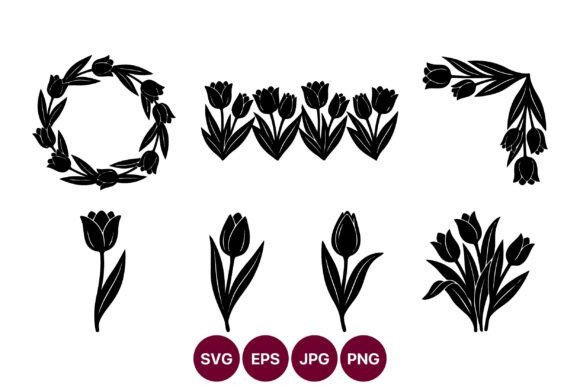
First impression? These aren’t dainty, frilly tulips. They’re bold, grounded, and quietly elegant—black silhouettes with subtle variation in posture: some upright and slender, others leaning gently, one or two slightly tilted like they’ve caught a breeze. There’s rhythm in the arrangement, not rigidity. As an embroidery designer who’s stitched hundreds of floral motifs—from overworked roses to pixelated daisies—I appreciate how Tulip Silhouettes Bundle avoids cliché. It feels intentional, not algorithmic. That matters when you’re building brand consistency for a small shop or choosing a motif that’ll live on a baby onesie for months of washes and snuggles.
Where It Shines: Real Projects, Real Fabric
I tested Tulip Silhouettes Bundle on a natural linen tote bag—medium-weight, loosely woven, no stretch. Stitched at 3.8" wide using standard tear-away stabilizer and 40-weight polyester thread, the design held crisp edges without bleeding or puckering. The clean lines translated beautifully into satin stitch outlines and smooth fill stitch interiors. No jagged corners, no fragile stems that vanished mid-stitch. That’s rare in vector-based embroidery files pulled directly from illustration assets.
It worked just as well on a heavyweight cotton sweatshirt—no shadowing, no distortion—even with the slight curve of the chest panel. I also ran it on a twill cap (front panel, medium curve) using cut-away + topping. The silhouette retained its shape and visual weight; customers wouldn’t mistake it for generic clipart. For Etsy sellers offering personalized gifts, that distinction is everything. A buyer ordering a “tulip-embroidered apron” expects something that feels handmade and considered—not mass-produced filler.
As nursery decor? Yes. On a muslin pillow cover or organic cotton swaddle, the simplicity reads as calming—not cold. And because the bundle arranges multiple tulips in a loose bouquet rather than a rigid cluster, it scales gracefully: use the full group for a tea towel centerpiece, isolate a single stem for a delicate baby cap, or flip and rotate elements to create custom layouts for boutique branding.
Where to Pause—and Why
This isn’t a one-size-fits-all embroidery file. Its strength lies in confident minimalism—but that means trade-offs. On highly textured fabrics (like bouclé knit or thick terry cloth), fine negative space between stems can fill in unpredictably. On ultra-thin fabrics (rayon challis, lightweight voile), skip the dense fill areas unless you add lightweight fusible backing—otherwise, thread shows through.
For curved surfaces like baseball caps or toddler beanies, avoid placing the tallest tulip directly over a seam or deep crown curve—it may distort slightly unless resized down to 2.5" or less. And while the black-on-white contrast is strong, don’t assume it’ll pop equally on dark fabric without testing thread color: charcoal gray or navy thread often reads richer than pure black on deep backgrounds.
Also note: this is an illustration, not a pre-digitized machine embroidery design. If you’re new to digitizing, Tulip Silhouettes Bundle will need conversion before stitching—especially if you plan to use it for applique design or layered satin stitch effects. It’s a high-quality graphics asset, not a plug-and-play embroidery file.
What It Adds to Your Finished Product—Beyond Aesthetics
Customers notice confidence. When a tulip motif looks deliberate—not traced, not stretched, not overly smoothed—it signals care. That perception lifts perceived value: a $38 embroidered kitchen towel feels more premium with Tulip Silhouettes Bundle than with a generic SVG flower pack. For craft fairs or boutique consignment, that subtle polish builds trust faster than any tagline.
It also supports versatility without dilution. You can use it across categories—holiday embroidery (think Easter linens or spring-themed baby gifts), wedding favors (monogrammed napkins), or small shop merchandise (logo-adjacent but not logo-dependent)—and still maintain visual cohesion. That’s invaluable for creative entrepreneurs juggling multiple product lines.
And for digital product sellers: Tulip Silhouettes Bundle works cleanly in printable mockups. Drop it into a flat-lay of a linen apron or a lifestyle shot of a ceramic mug, and it reads as authentic—not “designed for stock.” That realism boosts buyer engagement, especially for Etsy listings where thumbnail clarity and mood matter more than technical specs.
Practical Designer Notes Before You Stitch
- Always test on scrap fabric first—especially if pairing with textured or stretchy materials.
- Check stitch density in your digitizing software. High-density fills may overwhelm lightweight fabrics; reduce density by 10–15% for baby items or delicate linens.
- Confirm hoop size compatibility. The full bouquet fits comfortably in a 5x7 hoop, but tighter layouts (like a single tulip + monogram) may require 4x4 precision.
- Inspect small details at actual stitch size: petal tips, stem junctions, and inner negative space should remain legible—not fused into blobs.
- Test black-and-white mockups. Does the shape hold up in grayscale? Tulip Silhouettes Bundle does—making it reliable for blind embossing, heat transfer, or screen printing backups.
- Compare light and dark fabric backgrounds. Adjust thread color accordingly—not just brightness, but warmth (e.g., soft black vs. cool graphite).
- Use appropriate stabilizer: tear-away for stable wovens, cut-away for knits, and lightweight fusible for sheer layers.
- Verify licensing terms before selling finished products or bundling the files digitally. This is an illustrations download—not automatically cleared for commercial embroidery resale.
Final Thought: A Design That Lets Your Craft Speak
Tulip Silhouettes Bundle doesn’t shout. It anchors. It gives your embroidery project breathing room, clarity, and quiet sophistication. Whether you’re stitching a custom embroidered tote bag for a local florist, prepping holiday embroidery for a handmade shop, or building a cohesive line of nursery decor, this bundle behaves like a trusted collaborator—not a decorative afterthought. It rewards attention to detail and respects the integrity of handcrafted work. That’s why it’s earned space in my active design library—and why it might just earn a spot in yours.