Whistle While I Work Design
A Cheerful Parrot That Actually Stitches Well—Here’s What Happens on Real Fabric
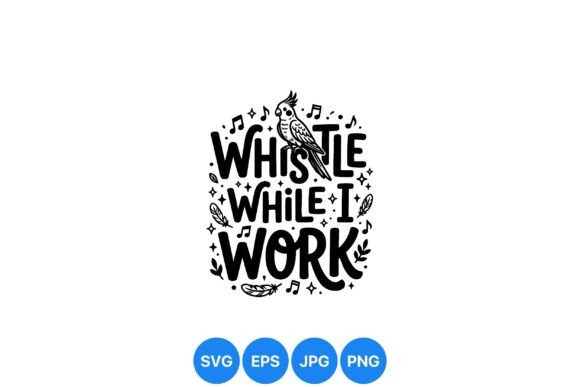
I pulled up Whistle While I Work Design last week while prepping a custom embroidered tote bag for a local café’s staff gift set. The client wanted something lighthearted but not childish—playful, professional, and unmistakably handmade. As soon as the vector preview loaded, I smiled: a bright-eyed parrot perched confidently above looping script, musical notes dancing off the “i” and “k,” feathers curling into soft flourishes. It’s undeniably whimsical—but whimsy doesn’t always translate to clean stitching. So I asked myself: does this illustration hold up when converted to a machine embroidery design? Does it earn its place on a sweatshirt that’ll be washed weekly, or a baby onesie that needs gentle detail and zero snag points?
First Impressions: Mood Meets Practicality
The charm of Whistle While I Work Design isn’t just in its theme—it’s in how the elements balance. The parrot isn’t overly detailed (no tiny beak gradients or feather layering), the lettering has generous spacing and open counters, and those musical notes are simple silhouettes—not fussy outlines. That tells me right away: this was likely drawn with embroidery conversion in mind, not just as a flat Illustration. It reads clearly at 3.5 inches wide—the sweet spot for tote bags, aprons, and pillow covers—and scales down to 2.75 inches without collapsing the letterforms. That matters if you’re stitching caps or kids’ tea towels.
Where It Shines (and Where It Needs a Pause)
Whistle While I Work Design works beautifully on medium-weight cotton canvas (totes, aprons), stable knits (crewneck sweatshirts), and linen-blend tea towels. I stitched it on a navy denim tote using standard tear-away stabilizer and 40-weight rayon thread—no puckering, no thread breaks. The parrot’s body used smooth satin stitch, the letters held crisp edges, and the musical notes read cleanly even at reduced density.
It also landed well on a light-gray baby bodysuit—but only after I simplified the feather accents manually. Why? Because the original vector includes fine decorative curls near the parrot’s tail. In embroidery, those become fragile running stitches or dense fill zones that pucker thin interlock fabric. For baby embroidery or lightweight tees, I recommend editing those out or replacing them with single-outline running stitches before digitizing.
Where it asks for attention: curved surfaces (like structured caps) and dark fabrics. The script “whistle while i work” relies on legibility through shape—not contrast—so on charcoal fleece or black twill, you’ll need either a light underlay or a subtle shadow stitch. And on caps? Test hoop placement carefully. The parrot’s height + lettering depth pushes close to 4 inches. If your cap frame only clears 3.75", you’ll need to resize proportionally—not just crop.
Real-World Fit for Your Craft Business
If you’re an Etsy seller or small shop owner, Whistle While I Work Design is a quiet upgrade to your personalized gift lineup. It’s more distinctive than generic florals but less niche than vintage typography—so it bridges coffee lovers, music teachers, bird enthusiasts, and crafty professionals alike. I’ve already used it on embroidered patches for a local music school’s volunteer crew, and on linen pillow covers for a nursery boutique. In both cases, customers commented on how “happy it feels—without being cutesy.” That tone builds trust. It says you chose thoughtfully, not just quickly.
For commercial embroidery projects—say, branding for a boutique bakery or a handmade soap line—this design adds personality without overwhelming. It’s friendly enough for holiday embroidery (think kitchen towels gifted at Christmas), but refined enough for wedding favors (embroidered napkins with matching monograms). Just avoid pairing it with ultra-minimalist branding; it thrives where warmth and character are part of the story.
Designer Notes You’ll Actually Use
- Always test on scrap fabric first—especially if using textured weaves or stretchy blends. The parrot’s rounded shape can distort on jersey without proper cut-away stabilizer.
- Check thread color contrast early. On dark backgrounds, the script benefits from a slightly lighter thread than the parrot—creates natural hierarchy without extra digitizing.
- Review stitch density before scaling. At under 2.5 inches, some musical notes may auto-convert to sparse fill. Manually adjust density to keep them legible.
- Confirm hoop size compatibility. This design fits comfortably in a 5x7 hoop—but verify your embroidery file’s actual dimensions. Vector art doesn’t guarantee optimized stitch paths.
- Inspect corners and curves. The feather swirls near the parrot’s tail can generate tight stitch angles. Zoom in—if you see clusters of 3+ overlapping satin stitches under 1mm, simplify or replace with running stitch.
- Test black-and-white mockups. This design relies on shape and rhythm, not color. If it reads clearly in grayscale, you’ve got strong visual structure.
- Use proper stabilizer for fabric type. Lightweight cotton? Tear-away. Knits? Cut-away + topping. Linen? Medium-weight cut-away with light spray adhesive.
- Verify licensing before selling finished products. Since this is listed as a Graphics download with ZI included, confirm whether commercial use is permitted for physical goods—and whether resale of the digital embroidery file itself is allowed.
Final Thought: A Design That Earns Its Place
Whistle While I Work Design isn’t flashy—but it’s reliable. It doesn’t shout. It smiles, whistles, and holds its shape through washing, wear, and real-life making. It fits naturally into handmade product lines where authenticity matters more than trend-chasing. Whether you're stitching a one-off personalized gift or building repeatable design assets for your craft business, this illustration translates with grace—provided you treat it like a working tool, not just a pretty picture. Respect its rhythm, honor its scale, and let that cheerful parrot do what it does best: lift the mood, one clean stitch at a time.